
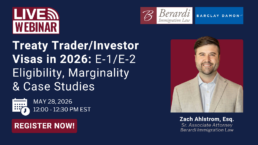
Transcript:
All right. Welcome, everyone. Welcome to our webinar series here at Priority Immigration Law. Today we have a good one for you. We’re going to talk about E-1 and E-2 visas in twenty twenty six. What we’re seeing, what’s working, what’s not working. Just to give everyone an up to date view of the landscape, given the current political climate, the changes in immigration policy that have been in the news. There have been a ton of changes throughout the past couple of years, but E-1 and E-2 visas, thankfully, have not been specifically targeted, and we’re still able to utilize these wonderful visa categories.
And we’ll get into how wonderful each of these visa categories are, a couple of the best options in the entire immigration system. So yeah, just to quickly introduce myself, I’m Zach Ahlstrom. I’m a senior associate at Berardi Immigration Law. I’ve been here for almost ten years now, and E-1 and E-2 visas is a primary focus of my practice and of the firm’s practice in general. We do a ton of E-1 and E-2 cases. I like to view this as one of our favorite and strongest categories. It’s definitely one of the strongest and best categories for clients if you’re eligible. And today we’re gonna dive into everything.
We’re gonna go over the requirements for both categories, common scenarios where we see the E-1 and the E-2 utilized. I’m gonna give you some real examples, some real world examples of E-1 and E-2 cases that have been successful. We’re gonna talk about what makes each of these cases strong, You know, what makes an E-1 visa strong? What makes an E-2 visa a strong application? And then we’ll dive into what’s changed, more specifically, what’s not changed. Because as you’ll learn here in a little bit, it’s mostly business as usual with E-1 and E-2 visas and a lot of the employment based categories that we deal with on a regular basis. So to start, we’re going to dive into the E-1 category. And the E-1 visa is a treaty trader visa.
And to give everyone a little bit of context, both the E-1 and the E-2 visa, they have a nationality requirement, meaning you have to possess the nationality of a treaty country with the United States in order to be eligible. And there are a ton of treaty countries. We handle a lot of Canadian applications, Canada as a treaty country, originally through NAFTA, now through the USMCA. There’s also many other treaty countries around the world. the UK, Japan, Australia, you name it, it’s probably a treaty country. Unfortunately, China and India are not treaty countries, but many other countries are, and it is an option to those individuals that are nationals of those countries. So the E-1 in particular is the treaty trader visa. The E-1 is focused on trade.
And there’s, you can think of it as three big primary requirements. One, you need, to be a national of a treaty country. That’s very easy to explain, very easy to demonstrate. Number two, you need to engage in substantial trade. Number three, that trade needs to be principally between the US and the treaty country. So what is substantial trade? So substantial trade is there’s no baseline number that they look for to determine substantiality. Rather, they’re going to look at the trade in general.
They want to see continuous transactions. sizable transactions, a continuous pattern in transactions over time. Those are the key sort of elements of a good E-1 treaty trade or visa application. You’re going to have a detailed track record of trade over an extended period of time and ideally into the future. You know, when you’re submitting an E-1 application, evidence of upcoming trade is very helpful. The E-1, there’s really two common scenarios that we see the most. Number one, you’re going to have a Canadian service company or a service company from a treaty eligible country. I’m using Canada as an example because we do do a lot of applications for Canadian.
It’s purely to give everyone an idea of how it works. So you have, say for example, you have a Canadian service company that has U.S. clients in the United States. They can use that E-1 Treaty Trader Visa to enter the United States to provide services to those clients. We just need to demonstrate that that trade, the revenue being generated from those contracts with U.S. clients is going to be deemed substantial and that this isn’t just a one-off, one-time deal with a U.S. client. You need more than that.
You need a continuous pattern, whether that’s you’re demonstrating that through past trade and more importantly, upcoming trade. you need to show that it’s both substantial and it’s principally between the US and Canada. So the way they determine the principle, the principally requirement is that they look at your international revenue. So take this Canadian service company. If they’re providing services to countries outside of Canada and the United States, we need to calculate that to determine what percentage of their overall revenue is being generated from international clients other than the US and Canada. If it’s less than fifty percent, You’re good to go. That means at least fifty percent of your international trade is with the United States. If it’s more than fifty percent, that’s where you’re going to have an issue.
That’s a very common E-1 scenario that we see is a service model company, a business model revolving around providing services to U.S. customers. Another example is say you have a Canadian company that has a U.S. subsidiary. The Canadian parent company provides administrative management services to the U.S. subsidiary. There’s recurring fees paid by the U.S. subsidiary to the Canadian parent company.
If this is significant, if this is a significant monetary value and this is a relationship that’s going to continue over time, this is another potential E-1 scenario. In this case, you could obtain E-1 status for the U.S. entity and this would allow individuals from Canada to come down and work for the U.S. company. So that’s another viable scenario. Another option, another common scenario we see is say you have a U.S. company that’s owned by Canadians. They could be a manufacturing business.
They could be in retail sales. It doesn’t necessarily matter. But say they buy all their inventory or all of their equipment or supplies from a Canadian supplier, whether that’s A non-related entity or a related entity doesn’t necessarily matter. If that is the international trade that they’re engaging in and then they’re selling or manufacturing domestically in the U.S., that’s another potential option for an E-1 case. And that manufacturing company is a good example of a real world case that I did recently. We had a U.S. company that was owned by Canadian citizens. They manufactured and sold blinds.
For windows, they manufactured windows themselves, and they sold domestically to the United States. Their inventory, all of their product, all of their supplies, their inventory was purchased from their Canadian parent company, and this was the requisite trade for E-1 visa purposes. We were able to get an E-1 visa for the owner of the business. They were able to come down and work for the U.S. entity. Another benefit of the E-1 category, this is also a benefit of the E-2 category, which we’ll talk about in a minute, is that the U.S. entity was registered as an e-visa business. And this registration was important because it allowed the U.S.
company to sponsor additional Canadian citizens for employee visas. So it’s not just a visa for the individual that owns the company. You get the business registered, and this is going to allow you to sponsor additional Canadian citizens. So if you need a bunch of your staff in the United States to work, the E-1 category is a great mechanism to accomplish that. And there’s no limit on the number of people that you can sponsor. We’ve had E-1 cases where the company needed, they have visas for a hundred, two hundred people. That’s the benefit of this category. Not only just providing that visa for the business owner and facilitating the trade between the two countries, but it also facilitates the transfer of personnel.
There’s a human component to this that allows businesses to have a lot of flexibility with their workforce and enable that workforce to work on both sides of the border. So it’s a huge benefit. I also did an E-1 case recently. This was a very interesting case because I’m a big golfer, but we had a golf course design business in Canada. They had a bunch of contracts with US clients. They go in, they design a course, they help renovate courses. um they provide a lot of services internationally but we were able to quantify we took a look at their international revenue determined that you know at least fifty percent of that revenue is coming from us-based clients this is a trend that was expected to continue over the next five years they have a bunch of big contracts lined up in the united states we included evidence of that uh and this was another great E-1 visa application in this case it was a Canadian-based service company The Canadian entity was registered and they were actually able to sponsor. They have about five or six employees in Canada that they were able to get employee visas for to come down to the US and help with the renovations and the actual design and build of golf courses in the United States.
They had some skilled golf course shapers, equipment operators, and even project managers that were able to go down and help with their US based projects. All right, so those are some good examples of real-world E-1 applications. Now, let’s quickly talk about what makes an E-1 application strong. So obviously, it’s pretty self-explanatory. You need strong evidence of trade, and documentation of that trade is critical. So you need contracts. You need invoices, you need bills of lading, you need a paper trail documenting the flow of that trade across the board. That is critical.
And it’s also important to demonstrate that this is consistent over time. You know, if you have one contract showing, you know, one transaction, even if it’s a large transaction, If there’s no consistency or there’s no additional work in the pipeline, that’s when you’re going to find yourself with a weaker E-1 application, because it can’t be determined that this international trade is going to continue. That’s what an officer really wants to see. They want to see numerous transactions of value over time. And that over time piece of this is just as important as the monetary value of your transactions. And if you really want to quantify what amount of trade is substantial, it really comes down to the nature of your industry, the nature and size of your business, the scope of your operations. There’s a lot of factors that play into that. But as a general rule, as long as the trade is more than enough to support the actual individual treaty trader and their family, you’re in a good starting point.
The case gets stronger, the higher the value of the trade, The longer the consistency over time piece of this, the better evidence you have to document that, the stronger your case is going to be. But at a baseline, you want to be able to show that the trade is more than sufficient to support the treaty investor and their family. And I’ve done treaty trader applications where the trade was as low as fifty, sixty thousand annually, which it’s on the lower end of the spectrum. But it’s still, you know, if you set it up right and you have the right documentation and you have evidence that there’s additional work in the pipeline and this involves numerous transactions over time. It’s a pattern that’s going to continue over several years. You can still build a strong E-1 application. You don’t need to be doing millions of dollars in trade to qualify for an E-1. All right, so what’s changed?
Has anything changed? In reality, not necessarily. There is a lot of media and there has been policy changes. There is additional scrutiny across the board when it comes to visa applications. With that said, a strong E-1 visa application today is just as strong as an E-1 application five years ago. It comes down to the strength of your application, the strategy that goes into developing an application and doing it correctly to give yourself the best chance of success. And if you can do that, these cases are still business as usual. You should not be deterred from pursuing an E-1 visa application or an E-tube visa application because of what you’re seeing going on with US immigration in general.
These cases are still very much viable, but it’s the same rule that’s always applied. You got to do it right. You got to have the right strategy going into this because the government takes immigration applications in general seriously, and you have to put forth a serious application to get approval. It’s just as doable now. And E-ones and E-twos, we’re going to talk about E-twos in a minute. They’re some of the best options available in the immigration system in general. If you don’t know about them, it’s time to learn about them because the E-1 and the E-2 are just fantastic. They provide longevity.
You know, you get potentially a five-year visa and your passport. This can vary depending on the country, your country of origin, your nationality. But Canadians, for example, you get a five-year visa and your passport. It’s renewable indefinitely. As long as you continue to meet the requirements of an E-1 or an E-2, you can renew that visa indefinitely. We’ve had clients with E-1 and E-2 visas for ten, fifteen plus years. That’s just a major benefit of this category. Your family can get visas.
Spouses can work. The company gets registered. You can sponsor additional employees to come to the United States to work for your business. There’s just nothing like this. in the immigration system. Nothing this beneficial and this overarching in terms of who can benefit from this. Your entire organization can benefit from this. All right, now moving into E-twos, which like an E-1 is a treaty visa.
This one, however, is focused on investment. Now the E-2 is the treaty investor visa. And at a baseline, the requirements are that you need to be a national of a treaty country. That’s obvious. You need to make a substantial investment in a U.S. entity. That investment must be at risk. The U.S.
entity must be a real and operating enterprise in a non-marginal business. That’s the core components, the key requirements of an E-2 visa. The investment piece of this is really tied to the nature of your business and what type of investment you are going to be making. It’s going to differ based on whether you’re investing in a startup or you’re purchasing an existing business in the United States. Two scenarios, both of which are extremely viable. From a startup standpoint, there’s two things that the government’s really looking at. Number one, is the investment, is the amount itself sufficient enough, significant enough, substantial enough to commit you to actually following through this enterprise? because what they don’t want is someone transferring fifty, forty, fifty grand to a U.S.
bank account and then doing nothing with it. They want to see that you’re actively investing or have already invested in a U.S. business that’s going to generate revenue, benefit the U.S. economy, create U.S. jobs. That’s the heart of this visa category. So in a baseline, is the amount enough to actually commit the person to following through with this? In practice, That generally is anywhere from sixty to one hundred thousand at a minimum.
Sixty thousand is definitely on the lower end for investment purposes. It’s still definitely doable as long as the case is structured appropriately. But that’s sort of the sweet spot that we like to recommend to clients in order to avoid avoid significant pushback and increase the chances of success. And oftentimes in granted, it’s a ton of money. It’s a ton of money for anyone looking to come invest in the United States, but it does add up quickly. We’ve had plenty of clients that are like, I don’t know how I’m going to invest sixty thousand. The business doesn’t need that much money. But by the end of the actual application process, by the time we have the application together, little things have added up and they’re much closer to that minimum threshold that we feel comfortable with than they would have expected initially.
In addition to that minimum threshold, officers also look at the nature of the business and whether or not your investment is substantial enough to allow the business to begin operating. You actually have to go and spend the money on the operational infrastructure needed for your company to operate. If the company is not ready to begin operations, when you were at your visa interview, they’re not going to approve the visa. And the best example of this is think of, take a manufacturing company, for example. Say you go and you purchase a two, three million dollar warehouse. If you don’t actually buy the equipment and the machinery you need to manufacture your product, yes, a three million dollar investment, obviously substantial, but you’re not going to meet that E-2, you’re not going to satisfy the E-2 requirements because your company is not ready to operate. You still have significant investment that needs to be made into the business before you’re operationally ready. Because you need that equipment.
You need the machines. You need the supplies and tools to actually manufacture the product and operate as a real business. Because if you don’t have that, you’re not a real operating company. You’re just an office. You’re just an abandoned warehouse with no actual business operations. So that’s the investment piece of it. Is the amount significant enough to commit you to following through the enterprise? Have you invested into the operational infrastructure of the business so that this can be a real and operating business?
Now, if you’re looking at purchasing an existing company, the analysis turns to the fair market value of the business and what your investment in the business is. If you’re investing a hundred percent of the fair market value of the business, you’re likely going to meet that substantial investment requirement. Now, a key piece to the investment itself, regardless of how or what type of investment you’re making, is that the investment needs to be at risk, meaning funds must be committed and subject to potential loss. So the best and easiest way to think of this is the money has to be spent. If you transfer a million dollars to a U.S. bank account, but you haven’t spent a dime of that on the business or operational expenses or startup expenses, you’re not going to qualify for an E-2 Visa because the money is not committed. It’s not at risk. So you actually for a startup, you have to spend the money on your startup expenses.
You have to purchase the equipment, tools, supplies that you need for the company to operate. If you’re purchasing an existing business, you can, this is sort of the exception to this, you can transfer funds into escrow on the condition that the funds will be released if your visa is approved. However, that must be the only condition on the release of funds. Otherwise, the funds won’t be considered at risk. If you’re using indebtedness towards your investment, say you take out a loan to fund your U.S. investment, that is permissible. But there are conditions that need to be satisfied for those funds to be considered at risk. And the biggest mistake that I see people make with loans is that they use the U.S.
enterprise itself as collateral for the loan. So that is a scenario where those loan funds will not count towards your investment. You need to take out a personal loan. The loan cannot be, it doesn’t necessarily just need to be a personal loan. The condition is the collateral for the loan cannot be the assets of the U.S. company or the U.S. company itself. That is the number one rule if you’re using loan funds for purposes of investing in an E-2 enterprise.
Now, if you look at the marginality requirement in the real and operating business requirement, this is what rules out nonprofits and sole proprietorships. So to qualify for an E-2 visa, you have to have the present or future capacity to generate significant revenue and hire US workers. If you’re buying an existing company that already has established revenue and an existing workforce and payroll, you’re likely going to meet this marginality requirement without much effort. For a startup, you generally need to include a business plan that outlines your hiring projections and your five-year revenue projections. This is important. This is critical to a successful E-2 application for a startup business because you need to show that, yeah, the company might be marginal now because it’s not really providing goods or services yet, but we’ve invested in the business. We’re ready to go. We just need the visa.
And then within five years, we’re going to have employees. We’re going to be generating significant revenue to support that business and our team. That’s what the government is looking at. And for new companies, you have five years to accomplish this. That’s one of the benefits of an E-2 Visa is that you have that long runway to build up your business and develop operations. And when it comes time to renew, that’s the primary focus of a renewal application is that marginality requirement. They’re not going to ask to see additional investment in the organization. It’s helpful if you have, if there has been a significant investment made since your original E-2 was approved, but that’s not the central piece of a renewal application.
A renewal application is going to focus on the marginality requirement. Does your company generate revenue? Do you have employees? That’s what they’re looking at. Is your company benefiting the U.S. economy? All right. So some case examples, some real world E-2 examples.
I’ve done E-2s for companies of all shapes and sizes. There is no limit to this. As long as it’s a real and operating business and you have the skill set to manage and develop a business like this, it can be accomplished. You know, I’ve done software companies, tool stores, construction companies, law firms, accounting firms, consulting firms, you name it, yoga studios, laundromats, restaurants. The E-2 is not just for companies. specific types of companies it is not just for massive large organizations it supports small micro medium large extra large companies of all sizes can benefit from the E-2 visa category and it supports businesses in every industry that you can imagine as long as it’s legal um okay so what makes an E-2 Visa application a strong case? Number one, the investment. That is by far and away going to be the central component of any E-2 Visa application if it’s an initial filing.
They need to see a full paper trail of your investment funds. Where did the money come from? Where did you send it? How is it spent? Quantify this. Demonstrate that this was a substantial investment in a U.S. enterprise. So we need bank statements.
We need invoices. We need receipts. We need a breakdown of your expenses. We need to categorize this. We need to present it in a neat, easy to understand, easy to read format. This is the centerpiece of a strong E-2 application is strong documentary evidence of your investment. The money has to be spent, and it has to come from a legal source, and we need to demonstrate that that’s true by documenting the full paper trail. That’s as simple as it can possibly be explained.
For new companies, and this goes for new and existing organizations, your investment, if this is an initial, your investment is going to be the centerpiece of a strong application. For new companies in particular, a business plan, a strong business plan is definitely going to be the next in line in terms of the key pieces of an application. What makes an E-2 Visa application strong? A strong business plan. Great evidence of investment and a really strong business plan. And the business plan can be short, it can be long, but it needs to be specific. and accomplish very specific purposes. It needs to explain what the company is, why this is a good venture, why you’re qualified to manage and direct this venture, explain the investment, and most importantly, explain how you’re going to grow, hire US workers, benefit the US economy, and be a non-marginal enterprise.
That’s the core purpose of a business plan is to demonstrate to the officer that’s reviewing a case that this company will not be marginal in five years. Ideally quicker than five years, but you have five years to do it. All right. So that’s from an E-2 Visa standpoint, it is that simple. It is document the investment, put together a strong business plan, or if you’re buying a company, document this acquisition. Document, document, document. That is the key. You need strong evidence.
You need a strong narrative, and it needs to present it. It needs to be presented to the government in an easy-to-understand way. Knowing your audience with these types of cases is very important. So the preparation in the presentation are essential to a strong E-2 Visa application. All right, so what’s changed? Just like E-1s, not much. You know, yes, like I said, there’s increased scrutiny across the board with Visa applications, but a strong E-2 is still a strong E-2. It’s business as usual.
Cases still get approved. We still do E-2 visas every single day for companies of all shapes and sizes, and they still get approved. The E-2, just like the E-1, is one of the greatest and best immigration options in our entire system. If you don’t know about the E-2, now there’s never a bad time to learn about the E-2. It’s a great immigration option. It supports the expansion of existing businesses. It supports entrepreneurs in creating new businesses. It supports the transfer and mobility of a workforce for existing companies with operations on both sides of the border.
The possibilities are endless. It’s a very unique category in the sense like the E-1, there’s scope to it. It can support your entire organization. Or if you’re just a single entrepreneur that wants to start up a small company in the US, maybe hire a couple people over five years, it’s perfectly suited for that scenario as well. Yes, immigration is front and center in the news, in the tabloids. It’s being talked about on every major media network almost every single day, but the E-1 and the E-2 remain unchanged. These are still wonderful visa categories, couple of the strongest in our system, and it’s still just as good of a time as ever to take advantage of these benefits in US immigration visas. All right, so that’s the E-1, E-2.
I want to thank everyone for joining us today, for listening to me ramble about these categories. I just love the E-1 and E-2. I wish everyone knew about them. I wish everyone that wants to come to the United States, that wants to invest in a business, that wants to engage in international trade knew about these categories and would take advantage. If you want to learn more, if you’re interested in either of these categories, or immigration in general, we do a ton of other work visa categories, green cards, naturalization, we do it all. Follow us on social media, check out our website. We’re very active on TikTok, Facebook, YouTube. We have a great YouTube channel with long form videos, short form videos.
We’re on TikTok. You can find us anywhere. We post regularly. You know, we have blogs uploaded to our website on a weekly basis. The news, current events, current trends, info about visa categories. We’ve got it all. Check us out. And yeah, always don’t hesitate to reach out if there’s anything we can do to help any questions you want to talk to an attorney uh we’re more than happy to do that we welcome questions we welcome comments um yeah thanks everyone and uh we’ll be back with another webinar here in a couple weeks.



Ready to have Berardi on your side?
Whether you’re a business looking to hire or a professional hoping to relocate, immigration law can be complicated. But you don’t have to do it alone. Put our experience to work for you.