Written June 25, 2026
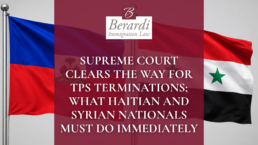
TLDR: On June 25, 2026, the U.S. Supreme Court ruled 6-3 that the Trump administration can end Temporary Protected Status (TPS) for Haitian and Syrian nationals, and that federal courts have no authority to block or review those decisions. The ruling directly affects approximately 330,000 Haitians and 6,000 Syrians living and working legally in the United States, and signals major uncertainty for the 1.3 million TPS holders from 17 countries overall. If you or someone you know holds TPS (or employs TPS holders) now is the time to speak with an immigration attorney.
What the Supreme Court’s TPS Ruling Means for Haitian and Syrian Immigrants
In a landmark decision issued this morning, the United States Supreme Court ruled 6-3 that the Trump administration has the authority to end Temporary Protected Status for nationals of Haiti and Syria, and that the courts cannot second-guess those decisions. The ruling, written by Justice Samuel Alito, effectively removes a critical legal safeguard that hundreds of thousands of people have relied on to live and work legally in the United States, in some cases for more than a decade.
For TPS holders, their families, and the employers who depend on them, this is not just a legal headline. It is a life-altering development. And the ripple effects extend well beyond Haiti and Syria.
What Is Temporary Protected Status (TPS)?
Temporary Protected Status is a humanitarian program created by Congress in 1990. It allows nationals of certain countries, countries experiencing ongoing armed conflict, environmental disasters, or other extraordinary conditions, to live and work legally in the United States on a temporary basis. TPS holders are thoroughly vetted, pay taxes, and must re-register regularly to maintain their status.
As of early 2025, approximately 1.3 million people from 17 countries held TPS in the United States.
Countries with TPS designations have historically included nations in the grip of serious instability, places like Haiti, Syria, Venezuela, Afghanistan, El Salvador, and others. The program is not a path to permanent residence on its own, but it provides a lawful, protected status while conditions in a home country remain dangerous.
What Did the Supreme Court Actually Decide?
The case before the Court involved two separate lawsuits, one brought by Haitian TPS holders and one by Syrian TPS holders, both challenging the Trump administration’s decision to terminate their respective TPS designations.
Secretary of Homeland Security Kristi Noem moved to end TPS for Haiti and Syria in 2025, concluding that the conditions that originally justified the designations no longer applied. Challengers argued that those terminations were procedurally flawed and, in the case of Haiti, motivated in part by racial bias.
Lower courts agreed with the challengers and blocked the terminations from taking effect. The Trump administration appealed, and the Supreme Court stepped in.
Writing for the majority, Justice Alito concluded that under the TPS statute, the Secretary of Homeland Security’s decisions about designating or terminating TPS are not subject to judicial review. In plain terms: the courts cannot block those decisions, even if they believe the process was flawed.
The Court also rejected the constitutional claim that Haiti’s termination was driven by racial animus, making it harder for challengers to find an avenue for relief.
The dissent, written by Justice Elena Kagan and joined by Justices Sotomayor and Jackson, was pointed: she wrote that there was “no dispute” that TPS holders would suffer serious, irreparable harm without the ability to pause the terminations during litigation.
Who Is Directly Affected And What Happens Next?
Haitian TPS Holders
Approximately 330,000 Haitian nationals hold TPS in the United States. They represent a cross-section of the American workforce: agricultural workers, nursing assistants, caregivers, teachers, business owners, and more. Haiti continues to face extraordinary levels of gang violence, political instability, and collapsed infrastructure. The U.S. State Department currently advises all U.S. citizens against traveling there.
Without TPS protection, Haitian nationals who do not have another lawful immigration status will effectively become undocumented, losing their work authorization and facing the prospect of deportation.
Syrian TPS Holders
Approximately 6,000 Syrian nationals hold TPS in the United States. Many have lived here for a decade or more. Syria remains in the midst of active regional conflict, and the U.S. State Department continues to warn against all travel to the country. Syrian TPS holders include doctors, medical professionals, journalists, and other community contributors who have been lawfully present and repeatedly vetted.
The Broader Impact on All TPS Holders
This ruling does not apply only to Haitians and Syrians. The Supreme Court’s decision effectively establishes that TPS terminations, for any country, are unreviewable by the courts. The Trump administration has already moved to end TPS for 13 of the 17 countries that had designations when the second term began.
TPS holders from other designated countries including Afghanistan, Cameroon, Venezuela, El Salvador, and others should closely monitor their own cases, as this ruling significantly weakens legal protections across the board.
What Should TPS Holders Do Right Now?
If you currently hold TPS, or if you employ workers with TPS, immediate action is warranted. Here is what we recommend:
- Consult with an immigration attorney as soon as possible to understand your specific situation and options.
- Assess whether you may be eligible for another immigration status (such as a green card through a family member or employer, asylum, or another nonimmigrant visa) that could provide lawful status independent of TPS.
- Do not allow your TPS registration to lapse while these matters are pending. Staying current on renewals preserves your options.
- Employers of TPS holders should consult with immigration counsel regarding I-9 compliance and workforce planning.
- Stay informed. This legal landscape is moving quickly, and there may be further developments at the legislative or administrative level.
Every case is different. There is no one-size-fits-all answer, which is exactly why having an experienced immigration attorney in your corner matters so much right now.
What Berardi Immigration Law Can Do for You
At Berardi Immigration Law, we have spent decades helping individuals and businesses navigate exactly these kinds of complex, high-stakes immigration challenges. We understand what it feels like to face uncertainty about your immigration status, and we know that the legal process, on its own, can feel overwhelming.
If you or someone you know is affected by this ruling, we encourage you to contact our team promptly. Time matters in immigration law, and in situations like this one, early action can make a meaningful difference.
TPS Is Uncertain. Your Next Step Doesn’t Have To Be.
Today’s Supreme Court ruling is significant, and the uncertainty it creates is real. But uncertainty does not have to mean helplessness. The immigration system is complex, and the path forward looks different for every person, but there is almost always a path, and finding it starts with the right guidance.
Berardi Immigration Law is here to help you find that path. Whether you are a TPS holder or an employer navigating workforce questions, our team is ready to help you understand your business immigration options and move forward with confidence. Contact Berardi Immigration Law today or call our office to schedule a consultation.
Frequently Asked Questions
Q: I currently have TPS. Does this ruling mean I will be deported immediately?
Not necessarily, and not immediately. The ruling removes the ability of courts to block TPS terminations, but deportation is a separate process. The timing of any enforcement action will depend on further government action. That said, you should consult with an immigration attorney now, do not wait. Understanding whether you qualify for another immigration status could make all the difference.
Q: Does this ruling affect TPS holders from countries other than Haiti and Syria?
Yes, potentially. While the case specifically involved Haitian and Syrian TPS holders, the Court’s ruling on judicial review applies broadly to TPS termination decisions for all countries. The Trump administration has already moved to end TPS for 13 countries. TPS holders from any designated country should speak with an immigration attorney to evaluate their options.
Q: Can Congress or the president still protect TPS holders?
Yes. Congress retains the power to pass legislation protecting TPS holders or creating pathways to more permanent status, and administrations can choose not to enforce terminations aggressively or to redesignate countries. These are political and policy decisions, not legal certainties, which is why having a clear picture of your individual immigration options remains essential regardless of what happens next.

Ready to have Berardi on your side?
Whether you’re a business looking to hire or a professional hoping to relocate, immigration law can be complicated. But you don’t have to do it alone. Put our experience to work for you.