
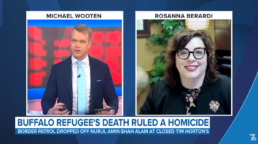
Transcript:
Michael Wooten: We’ll start here with breaking news tonight. The death of a partially blind refugee who was living in Buffalo, and whose body was found out in the cold five weeks ago, has been ruled a homicide. Border Patrol agents picked up Nurul Amin Shah Alam from the Erie County Holding Center. But after realizing that he wasn’t subject to deportation, agents dropped him off at a closed Tim Hortons on the west side of Buffalo, a place Customs and Border Protection described as “a warm, safe place.” His family, though, points out that he wasn’t even wearing shoes, didn’t speak English, and had mobility issues, and that the restaurant was closed. The medical examiner says specifically that he died from a perforated stress ulcer that was related to hypothermia and dehydration. And again, the manner of his death was homicide.
Attorney Rosanna Berardi joins me live here tonight. She’s managing partner at Berardi Immigration. Rosanna, it’s always great to see you. I want to point out here, the medical examiner, the health commissioner, and others made clear today, that just because a death is ruled a homicide doesn’t mean that there was a crime. But I think it does beg the question for community members: is there at least an investigation going on into all of this? I don’t think people have a lot of confidence that the Department of Homeland Security is investigating what happened. What do you make of what the medical examiner said today?
Rosanna Berardi: Well, it was certainly tragic to hear this news. This story, in my opinion, just keeps getting worse and worse as it continues. But as you said, the medical examiner’s finding is not a criminal indictment, but it does say that somebody, a person or persons, was responsible for Mr. Alam’s death.
So what are the next steps? We’ve heard several politicians, the Attorney General’s office, and some local politicians here in Buffalo state that they are investigating the medical determination, as well as the District Attorney’s office. Now, it’s very difficult to prosecute federal agents. There are a lot of protections that go along with that job. I’m not expecting a criminal indictment here, but I am expecting to see some type of civil lawsuit saying that Mr. Alam’s rights were violated.
Michael Wooten: Yeah, and his family has retained local counsel, and we would expect that there would be civil action. Can you just talk a little bit more, Rosanna, about qualified immunity, which is given to federal law enforcement officers? And how difficult is it? We think of what happened in Minneapolis with two protesters who were shot to death by CBP Border Patrol agents. It’s really difficult for local authorities to prosecute at the federal level, isn’t it?
Rosanna Berardi: Absolutely. The immunity that attaches to work done while a federal agent is working, it’s a really, really high bar. Even if they can show that the agent may have made a bad decision, that agent is covered and protected by this immunity that allows him or her to escape criminal prosecution. It’s going to be very difficult in terms of criminality. But like you said, the civil lawsuit will likely go forward, and it will likely be difficult for CBP or Border Patrol or ICE to defend what actually happened here. Mr. Alam was lawfully in the United States. He did everything right. He was a refugee, and obtaining refugee status is one of the hardest statuses to obtain under the law. Unfortunately, the procedure and the process for his release went off the rails, and a tragedy has occurred.
Michael Wooten: Yeah, most definitely a tragedy. Just to be clear, again, we do not know that the actions by these Border Patrol agents were criminal. Hopefully we’ll get some answers as to just what transpired, because so many questions remain.

Ready to have Berardi on your side?
Whether you’re a business looking to hire or a professional hoping to relocate, immigration law can be complicated. But you don’t have to do it alone. Put our experience to work for you.