
Transcript:
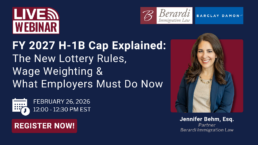
Hello, everyone. Welcome to our webinar today to discuss the H-1B lottery for fiscal year twenty twenty seven. We’ll give our guests a few more moments to join us and then I’ll dive into a very lively but keep it short session on the H-1B lottery and what we can expect this year. We’ll give everyone another half a minute to join. Grab your lunch, grab your beverage. It is a cloudy Thursday here in Buffalo. All right. Well, welcome everyone to Berardi immigration laws webinar in tandem with Barclay Damon. I’m Jennifer Behm. I’m a partner with Berardi Immigration Law and Immigration Counsel for Barclay Damon’s Clients. Thrilled to be here today.
We have a quick presentation to discuss and explain the H-1B visa and the annual lottery. My contact information will be at the end. So if you have any follow-up questions, please don’t hesitate to email me directly, connect with me on LinkedIn, follow along. There are lots of things happening on the immigration front, and we are always staying on top of those trends, posting a lot on our blog, posting a ton of content on LinkedIn across all of our attorneys and our entire legal team. So please follow along for the latest and the greatest.
Today, we’re going to dive into the H-1B visa category. Most of you listening today are probably already familiar with that, but let me explain. What is the H-1B visa? So under our US immigration system, when it comes to individuals who are not American citizens, who have job offers in the United States, there are just a very small handful of visa categories that allow someone to legally work in the US when being sponsored by a US employer. The H-1B visa is for individuals who have professional job offers in what we call a specialty occupation. And that’s defined as a job that requires at least a bachelor’s degree or higher in a specific field. The H-1B is issued in three-year increments. It’s valid for up to six years. Certain individuals are eligible for extensions beyond that six-year cap. We’re not going to get into that today, but okay, this sounds great. H-1B visa, work visa, what’s the catch?
Well, the demand for H-1Bs greatly is exceeded by a congressional limit that is set. So each year, Congress limits the number of H-1B visas available, and that leads to something called an H-1B lottery, an H-1B cap. Are we able to get to the next slide? Here we go. So what happens is every year, Congress limits the number of H-1B visas new to eighty five thousand. Now, sixty five thousand of those are reserved for an individual who holds a bachelor’s degree or equivalent that can be an equivalent foreign degree. It can be an equivalent through work experience. And then on top of that, there’s an additional twenty thousand that are reserved for individuals who graduate from a U.S. master’s program or a U.S. higher degree. So twenty thousand of those are reserved for U.S. educated foreign nationals with a master’s or higher. The issue is that the demand for an H-1B visa is greatly exceeded by those statutory limits. And what happens is a lottery system has been created to randomly-ish pull those eligible applicants. To put some context to the numbers of the demand far exceeding the supply is that last year there were over seven hundred thousand H-1B applicants for one of those eighty five thousand slots.
The lottery system going into our next slide is very it runs annually each year. There are some key dates to keep in mind this year that lottery registration window where employers and their legal counsel will submit names and some basic information about their employees who they want to put into the H-1B lottery. That window will occur from March fourth to March nineteenth. So if you’re a US employer tuning in today, you definitely want to get some information prepared in advance so that you’re ready to go during that window. And we’ll talk about that in a moment. The lottery will close after March nineteenth by noon Eastern Standard Time. So keep your eye on that time frame. And by March thirty first, we expect that employers will be notified which of their H-1B applicants are selected in the lottery.
Once they’re selected, employers and legal counsel have a ninety day period to file an H-1B petition with US Citizenship and Immigration Services. Everything is done in paper or online through through the mail. And this is what some immigration attorneys have dubbed our tax season, right? We’re all scrambling to get everybody submitted timely into the H-1B lottery, get those petitions prepared and filed for the selected applicants. And depending on whether the government allows cases to be filed for expedited processing through an additional premium processing fee, if you will, which is nearly going to be three thousand dollars plus government fees, You’ll know if your H-1B is approved or if the government needs additional information. Regular processing will probably take upwards of eight plus months.
The earliest an H-1B employee can start with this H-1B cap is October first of 2026. And that’s aligned with the start of the government’s fiscal year for 2027.
Now let’s talk a little bit about the wage-weighted H-1B system. Previously, USCIS would totally randomly select names in the lottery process. This year, they’ve rolled out a new wage-weighted system. The current administration has likened higher wages and occupations to be those who are most deserving of an H-1B selection. So on this chart, well, let me take a step back. If you’re not aware, the Department of Labor publishes tons of wage data for all the geographic areas in the United States. And for every occupational code, so different jobs have different occupational codes, you can pull the wage levels for the geographic area of that particular job field.
So let’s take an example of a software developer in Buffalo, New York. I don’t have those wages in front of me, but the different levels of those wages for that software developer will be a reference point when you are analyzing how you are going to strategize the individual submission in the lottery this year. The government says that wage level one job offers for H-1B will get one entry into the lottery for one of those coveted numbers. Those who will be paid a base salary at level two or higher will get two entries. If their wage level is at level three, which indicates more experienced applicants, they’ll be eligible for three entries. And so your chances increase, of course, going to level four, you’ll get four entries. Your chances increase that if you have a higher wage level for your occupation in that geographic area, your chances for selection will go up.
There’s a lot of individuals who are not happy with this. So if you think about it, we have certain graduates who are coming in at entry-level wages. They may not have as much of a chance to get their name selected in the lottery. There are also concerns about how this will have a disparate impact on different geographic areas. So higher wage levels, bigger metropolitan areas. that generally come with higher wage scales may be either advantaged or disadvantaged. It’ll be really interesting to see how this data shakes out. But right now, this is the system that we are working with.
So for employers who are planning, and I’ll come back to this at the very end of our presentation, those of you who are planning on salary comps and looking at your H-1B employees, Keep in mind that that October first start date, that’s the wage that you’ll be wanting to offer to your H-1B employee. And so if they’re a current employee and they’re only making X amount of dollars and that’s aligned with wage level two, but perhaps they’re due for a salary increase or you know that they are lined up for a promotion that they’ll hold a higher paying position by October first.
You may want to strategize and really keep that in mind and use that to your advantage to increase their entries into the lottery this year. When it comes to wages, we always have clients ask, well, can we count the value of benefits or bonuses or commissions? Unfortunately, that compensation will not count towards the base wage level for H-1B purposes. the Department of Labor will only allow us to consider their base salary and any guaranteed compensation as part of their base pay. So keep that in mind. And this can get tricky for individuals that are in commission-based roles. You really will want to flip maybe their compensation structure. But of course, that can have some trickle-down effects to the rest of your company. So lots of things to consider here.
And this is kind of just the basic introduction to this wage weighted system.
Going into another issue that we are seeing this year on the H-1B front. So you’ve all probably heard about the one hundred thousand dollar H-1B proclamation fee. The current administration issued an executive order back in September of last year that said anyone who is outside of the United States and has a petition filed after September thirty first twenty twenty five is going to have to pay a one hundred thousand dollar fee before they can obtain H-MB work authorization.
This caused a lot of panic and chaos initially. It does not apply to individuals who are in the United States, but is really focused on applicants that are physically present outside of the United States. And if you really dig into some of To the proclamation when it was issued back in September, the administration was really targeting third party IT companies, if you will, that bring in lots of applicants under the H-1B lottery who really may not have had any ties in the United States. That seems to be their target. Unfortunately, it did impact a lot of other H-1B employers. We’re not going to get into that today. But I do want to further clarify that in our practice, most and many of our clients who are already here in the United States, U.S. employers who have employees who are already in the United States, that H-1B fee probably will not apply to them. So it will not apply in this cap season.
Next slide, please. To the beneficiaries. who are currently in the United States invalid status. So we see this often for F-1 students who are working with their OPT or STEM OPT. If their employer is filing a change of status from F-1 for their graduate student to an H-one B effective October first of 2026, that petition will not be required to pay the one hundred thousand dollar fee.
Now, if you’re a U.S. employer and you have a candidate, for example, in London or in Australia, and you really want to bring them in as a new employee and they don’t really have any other ability to enter the United States to file a change of status, that candidate would be eligible or that petition would be eligible or required to show proof of payment of the one hundred thousand dollar fee.
So if you’re tuning in today and you have questions about whether or not this one hundred thousand dollar fee will impact your eligible or your hopeful H-1B candidate, definitely reach out to us and we can help, you know, dive into. Well, no, your case will probably be exempt from that fee.
I also want to note that a recent Supreme Court decision regarding President Trump’s tariffs, had some language in there that alluded that this one hundred thousand dollar fee is effectively um a tariff that is not permissible so we are seeing some lawsuits um around this issue and it’s something that we’re very very closely watching okay
So what happens if your petition is selected? Well, remember that registration window closes and mid to end March, employers and their immigration counsel begin to receive notices in their My USCIS account. All of this thus far is done electronically through a government portal that the employer and legal counsel will work together to manage. When the petition is selected, that’s great. And then the employer will have ninety days to file that full petition.
part of the standard H-1B process involves obtaining a certified labor condition application from the U.S. Department of Labor. And that’s essentially where the employer is committed to giving notice to U.S. employees that they are sponsoring an H-1B worker and they’re not undercutting the hiring of American workers with paying that individual lower wages.
Employers are also required to maintain something that’s called a public access file or a PAF. This is a super important aspect of being an H-1B employer. It is part of the compliance structure and it’s showing the government or anybody who, if they requested to look at the public access file, they technically could. It’s showing that the company is paying them fair wages. It’s a real operating enterprise and that they are hiring or bringing in this candidate, that the candidate has the requisite education and possibly experience for the role. Okay.
Is there any company that is exempt from this H-1B lottery system? There are a few. Keep in mind that the H-1B lottery, because of the demand, this is only running one time a year for the most part. Sometimes there may be a second swoop, a second lottery that the additional names that weren’t selected in round one will be pulled from. But I wouldn’t count on that. And we generally advise our clients to assume that this probably will not happen.
So are there any employers exempt from this lottery process? The government has designated certain types of entities that are exempt, and those are listed here. Universities of higher education, university-affiliated nonprofits, like teaching hospitals is a common one that we often see, nonprofit research organizations and government research organizations, and then anyone who was previously selected in the H-1B lottery is not required to go through the lottery again.
So if that candidate is moving from one company to another and they had been previously selected in the lottery, they can file an H-1B transfer at any time throughout the year. Same thing for extensions. If they are working with their company that had them selected in the lottery and their three years is coming up for renewal, an extension can be filed as well.
Something else to keep in mind for employers who are listening in today. H-1Bs are very specific in terms of compliance obligations. And one thing to keep in mind is that the H-1B and labor condition application that I had mentioned earlier that’s certified by the DOL before approval, these are all based on where the applicant is physically working. H-1Bs are based on where the applicant is physically working when they are performing their work. So that means the job and the wage analysis is based on their work site address, the actual work site address.
And if it’s somebody who works from home, the wage analysis is going to be based on that physical work site, their home address. If there are any changes in work site addresses, make sure you report that into your immigration council because sometimes amendments could be required. So definitely give some thought to that.
And finally, what should employers be doing now to prepare? Well, if you haven’t already, you want to make sure that you’re looking at your current employees and what is their current work authorization if they’re non-American citizens or non-Greek card holders. We often see requests for H-1Bs by F-Bs. students working in OPT or STEM OPT.
So you want to identify your candidates early and make sure that they, if you’re putting their name into the lottery, that they are being offered an appropriate job in a specialty occupation to obtain an H-1B.
Excuse me, you also want to work with Immigration Council to again, maybe strategize those wage levels and the strategy, the wage levels and their pro-offered salary for an October first start date in H-1B status.
There could be a little bit of flexibility to be had to give applicants maybe a little bit more of a leg up than what was previously thought of in past years where it’s really just truly a random selection process.
Immigration counsel will ask for certain documentation, including proof of the applicant’s educational credentials, their job description, all of their worksite locations. So make sure as an employer and if you’re an applicant tuning in that you’re very transparent with your worksite locations where you regularly perform your job duties and job tasks.
And then, of course, stay in touch with Immigration Council. Right now, we’re working with our clients to make sure that they have access to their My USCIS account, that they are adding Immigration Council so that we can help facilitate that process.
And again, it’s a very short window that starts in March, and it really only runs for just a few days. It comes before you know it. March fourth, that open registration window will be here in the blink of an eye. So preparation is key to having a smooth registration process.
And that’s it. That’s what we have for today. This QR code will lead you to my LinkedIn. Again, feel free to reach out to my email address if you have any questions about the H-1B lottery. Thanks for tuning in today. Go grab your lunch and enjoy the rest of the week.



Ready to have Berardi on your side?
Whether you’re a business looking to hire or a professional hoping to relocate, immigration law can be complicated. But you don’t have to do it alone. Put our experience to work for you.