

Written August 17, 2026. Reviewed by Rosanna Berardi, Esq., Managing Partner
TLDR:
- Owning a successful company abroad does not, by itself, qualify you for an L-1A visa. DHS is testing whether your U.S. operation can genuinely support an executive or managerial role, not just whether you’re wealthy or the boss.
- New office L-1A petitions get the highest level of scrutiny of any L-1 filing, and adjudicators focus on a specific set of pressure points: the ownership chain, whether both companies are truly “doing business,” physical premises, capitalization, and the staffing plan that gets you out of the weeds within a year.
- Founder-led companies with lean teams, outsourced functions, or layered holding structures face predictable red flags. They are, however, fixable with the right documentation and planning.
- Use the readiness scorecard below to stress-test your own expansion before the government does it for you.
Why “I Own the Company” Isn’t the Same as “I Qualify”
If you’ve built a successful business abroad, it’s natural to assume that founding, funding, and running that company should make an L-1A petition straightforward. You’re not a junior employee being transferred, you’re the person who built the thing.
DHS doesn’t see it that way. The L-1A category was designed to move executives and managers between related companies, not to give business owners an automatic path to a U.S. address. Adjudicators are trained to look past titles and ownership stakes and ask a narrower question: once this person lands in the United States, will the actual structure of the business allow them to function primarily as an executive or manager (not as the one person answering the phones, closing sales, and doing the bookkeeping)?
For founders with substantial personal wealth or an already-thriving foreign company, that gap between “successful business owner” and “L-1A-eligible executive” is the single most common reason strong companies get hit with Requests for Evidence or denials.
This is where a stress test is useful. Before you file, it helps to evaluate your expansion the way an adjudicating officer will: line by line, looking for the places the structure might not hold.
What USCIS Is Actually Testing
An L-1A new office petition asks USCIS to approve something that doesn’t fully exist yet: a U.S. operation that, within one year, will be substantial enough to employ the petitioner in a primarily executive or managerial capacity. That forward-looking element is what makes new office cases harder than standard L-1A transfers, and it’s why officers scrutinize a handful of specific pressure points.
1. The Ownership and Corporate Relationship Chain
USCIS needs to see, with documentary clarity, that the U.S. entity and the foreign entity share a qualifying relationship (parent, subsidiary, branch, or affiliate) through common ownership or control. For founders with a single straightforward company, this is usually simple. For founders with layered holding companies, multiple affiliated ventures, or ownership split across family trusts and investment vehicles, this becomes one of the first places a petition can unravel. Every link in the ownership chain needs a paper trail: stock certificates, cap tables, operating agreements, and organizational charts that tell a consistent story.
2. Whether Both Companies Are Genuinely “Doing Business”
It isn’t enough for the foreign company to exist on paper. USCIS wants evidence that it has been actively providing goods or services on a regular, continuous basis and not simply holding assets or maintaining a registered address. The same standard eventually applies to the U.S. side. A foreign operation that looks more like an investment vehicle than an operating business is a common vulnerability for wealthy founders whose foreign entity was built around holdings rather than day-to-day operations.
3. Physical Premises
Officers want evidence that appropriate physical space has been secured for the nature and stage of the business: a lease, a floor plan, or photographs showing the space is suited to actual operations, not just a mailing address for the petition.
4. Capitalization
The U.S. entity needs to show it has the financial resources (through owner investment, foreign parent funding, financing, or a combination) to sustain operations and support a growing team for at least the first year, independent of speculative future revenue. Founders sometimes assume that personal wealth answers this question by default. It doesn’t. USCIS wants to see funds specifically committed to the U.S. entity, not simply evidence that the founder is personally well-off.
5. The Staffing Plan and the One-Year Runway
This is often where founder-led petitions are weakest. USCIS wants a credible, detailed hiring timeline showing how the U.S. company will grow enough in headcount, org structure, and delegated functions that within one year the petitioner is functioning primarily as an executive or manager rather than as the person actually doing the work. A staffing plan that leaves the founder as the only full-time employee, surrounded by outsourced vendors and contractors, is a frequent source of Requests for Evidence.
6. The Executive or Managerial Duties Themselves
Finally, USCIS looks closely at what the petitioner will actually do day to day. Titles like “CEO” or “Managing Director” carry little weight on their own. The duty description needs to show a role focused on directing the organization, setting policy, and exercising wide discretion and not performing the operational, technical, or sales tasks the business needs to survive its early days.
Red-Flag Matrix for Founder-Led Businesses
Certain company structures draw more scrutiny than others. If your business matches one or more of the patterns below, it doesn’t mean your case is unwinnable, it means these are the areas that need the most deliberate documentation.
- Lean or solo-founder teams. If the petitioner would be the only U.S.-based full-time employee at filing, USCIS will look hard for a specific, dated hiring plan rather than a general statement of intent to grow.
- Heavily outsourced functions. Businesses that rely on contractors, freelancers, or third-party agencies for core operations can struggle to show a “staff” the executive is actually managing, as opposed to vendors the founder is personally coordinating.
- Layered holding companies. Multiple entities stacked between the founder and the operating business make the qualifying relationship harder to prove and invite closer review of who actually controls what.
- Multiple affiliated ventures. Founders running several related companies need to be precise about which entity is the actual petitioner and employer, and be prepared to show the petitioner’s time and duties are genuinely dedicated to that one U.S. operation.
- Foreign entity built around passive holdings. If the foreign company primarily holds investments, real estate, or other assets rather than actively operating a business, the “doing business” requirement becomes a central issue rather than a formality.
- Founder wealth substituting for entity capitalization. Personal net worth, without funds specifically and traceably committed to the U.S. entity, does not satisfy USCIS’s capitalization expectations.
Executive-Readiness Scorecard
Use this as a quick self-assessment before you begin building your petition. For each area, ask whether you currently have strong, contemporaneous documentation and not just a plan in your head.
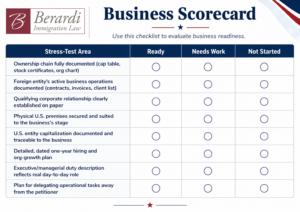
If more than a couple of rows land in “Not Started,” that’s not a reason to abandon the expansion. Instead, it’s a signal to build out the missing pieces before filing, when there’s still time to get it right.
What This Means for Your U.S. Expansion
None of this is meant to suggest that founder-led companies can’t succeed with L-1A. They do, regularly. But the petitions that hold up under scrutiny are the ones built around the actual operational reality USCIS is testing for, not around the assumption that ownership and success abroad speak for themselves.
The strongest new office petitions treat the filing the way a serious business expansion should be treated from the start: with a real staffing plan, real capitalization, and a clear-eyed picture of what the founder’s role will look like in year one.
Passing Your Own Stress Test Before USCIS Runs Its Own
A founder’s success abroad is a genuine asset in an L-1A case, but only when it’s translated into the specific evidence USCIS is looking for: a documented ownership chain, active operations on both sides, secured premises, real capitalization, and a credible path to an executive role within a year. Running your own stress test before you file is one of the best ways to catch the gaps while there’s still time to close them. At Berardi Immigration Law, we work through this evaluation with founders and business owners at every stage of expansion, so the petition reflects the strength of the business you’ve actually built. Nobody should navigate immigration alone, and that’s especially true when the stakes are a U.S. expansion you’ve worked years to build. Click here to book your consultation today.
Frequently Asked Questions
Q: Does having a lot of personal wealth help my L-1A case?
Not directly. USCIS is evaluating the U.S. entity’s capitalization and operational readiness, not the founder’s personal net worth. Funds need to be specifically and traceably committed to the U.S. business to count as capitalization evidence.
Q: What happens if my staffing plan doesn’t pan out exactly as filed?
Some deviation is common, and USCIS understands that early-stage businesses evolve. What matters most at extension time is being able to explain any changes clearly and show that the company is still on a credible path toward supporting the petitioner in an executive or managerial role.


Ready to have Berardi on your side?
Whether you’re a business looking to hire or a professional hoping to relocate, immigration law can be complicated. But you don’t have to do it alone. Put our experience to work for you.