Written September 10, 2026. Reviewed by Rosanna Berardi, Esq.
TLDR:
- TN status requires a genuine employer-employee relationship. Self-employment is explicitly prohibited, and USCIS has been scrutinizing owner-employee cases more closely than ever.
- Owning equity in a company does not automatically disqualify you from TN status, but controlling the company usually does, unless the corporate structure clearly separates your ownership stake from your day-to-day supervision.
- Founders, portfolio-company executives, and family-business owners can often still qualify. It takes deliberate governance, capitalization, and documentation choices made before filing, not after an RFE arrives.
- When the numbers or the control simply won’t support TN, other categories (L-1, O-1, or H-1B) may be a safer and more durable fit.
Why Ownership Keeps Coming Up in TN Cases
Founders and business owners come to us with some version of the same question: “I have equity in this company, can I still get a TN to work here?” It’s a fair question, and it’s more common than it sounds. Family businesses bring in a Canadian or Mexican relative to run operations. Investors take an active executive role in a portfolio company. Entrepreneurs incorporate in the U.S. and want to work in the very company they built.
None of that is unusual in the business world. But TN status was built around a narrower idea: a U.S. or Canadian/Mexican employer offers a job to a professional, and that professional works for the employer, under its direction. The regulations governing TN status (8 CFR § 214.6) and the State Department’s Foreign Affairs Manual are explicit that self-employment does not qualify. USCIS has also sharpened its focus on this issue in recent Policy Manual updates, adding more scrutiny around who the employer actually is and whether a real employer-employee relationship exists, not just a contract for services.
That means the ownership question isn’t really about equity at all. It’s about control. Understanding that distinction is the difference between a TN that sails through and one that draws a denial.
The Real Test: Control, Not Ownership Percentage
There’s a common misconception that any ownership stake creates a self-employment problem, or conversely, that staying under 50% ownership automatically solves it. Neither is quite right. USCIS and CBP officers are trained to look past the cap table and ask a more practical question: who directs this person’s work?
Officers typically weigh:
- Who supervises the applicant day to day? Is there someone with independent authority to direct, evaluate, and if necessary terminate the applicant’s work?
- Who sets compensation, and how? Is the applicant paid a salary through payroll, or do they draw profits/distributions tied to ownership?
- Who governs the company? Does a board, other officers, or outside investors have real authority, or does the applicant have final say over their own role?
- Is the arrangement genuinely temporary? TN status is built around temporary professional engagements, not permanent ownership-driven roles.
A founder with 80% ownership but an independent board that can direct and remove them presents a very different case than a founder with 20% ownership who is, in practice, unsupervised and unaccountable to anyone. The percentage on paper matters less than who actually holds the reins.
Where This Gets Complicated: Founders, Investors, and Family Businesses
The Founder Running Their Own Company
This is the highest-risk fact pattern. If you started the company, sit on its board, and no one else has meaningful authority over your role, USCIS is likely to view the arrangement as self-employment, even if the company is well-capitalized and has other employees. The fix usually isn’t abandoning the structure; it’s building in real, exercisable oversight. Consider an independent board majority, outside investors with governance rights, or a co-founder/CEO with genuine authority over the applicant’s position.
The Investor Taking an Operating Role
Private equity and venture-backed founders often bring in a Canadian or Mexican executive to run a portfolio company post-investment. These cases can be strong TN candidates if the investor’s control is documented. Board seats, voting agreements, and the operating agreement should reflect that the fund (not the executive) holds ultimate authority. The petition should tell that story clearly, not leave it implied.
The Family Business Successor
Bringing in a family member to manage or eventually take over a business is common, but it raises the same control question in a more personal context. If Mom or Dad remains the actual decision-maker (with documented authority to direct and evaluate the family member’s work) this can be structured successfully. If the family member is already running the show in substance, the label on the org chart won’t fix that.
A Simple Way to Think About the Structure
Picture three tiers of control in any TN-eligible arrangement:
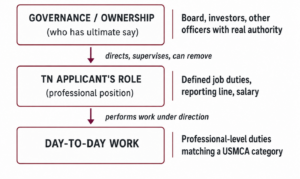
The stronger the documented separation between the top tier and the applicant, the stronger the case. Weak or circular arrangements, where the applicant effectively occupies all three tiers, are exactly what draws scrutiny.
Building a Petition That Holds Up
For founders, investors, and owner-employees, a strong TN petition typically documents:
- Corporate governance records — bylaws, operating agreements, board resolutions, and cap tables showing who actually holds decision-making authority.
- A clear reporting structure — an org chart and job description showing a named supervisor with genuine authority, not a nominal one.
- Payroll and compensation records — W-2 wages consistent with an employee, distinct from profit distributions tied to ownership.
- Evidence the arrangement is bona fide and temporary — not a permanent ownership-driven role dressed up as employment.
This is exactly the kind of documentation-heavy, structurally aware petition that gets built well before a filing deadline, not assembled in a panic after an RFE.
When TN Isn’t the Right Fit
Sometimes the honest answer is that TN status simply won’t work for a given ownership structure, and pursuing it anyway just invites a denial and a paper trail that complicates future filings. In those cases, other categories are often better suited to owner-driven roles:
- L-1 status is specifically designed for multinational executives, managers, and specialized-knowledge employees moving within a related company structure, and can accommodate more ownership and control than TN.
- O-1 status may fit founders and executives with a demonstrated record of extraordinary ability or achievement in their field.
- H-1B status, while subject to the annual cap and lottery, can work for owner-employees in some structures, particularly with appropriate independent oversight.
Choosing the right category up front, rather than forcing a TN into a role it wasn’t built for, is often what separates a smooth process from a stalled one.
Finding The Correct Structure For Your TN Role
Owning part of the business you want to work for doesn’t automatically close the door on TN status, but it does raise the bar. USCIS wants to see a real employer-employee relationship, and for founders, investors, and family-business owners, that means proving it through governance structure, not just describing it in a cover letter. Getting this right takes an honest look at who actually controls the role. And sometimes, it takes an honest conversation about whether a different visa category is the safer path.
Nobody should navigate immigration alone, and that’s especially true when the stakes involve your own company. An experienced immigration attorney can help assess your ownership and governance structure early, before a petition is filed, so the arrangement is built to withstand scrutiny from the start. Book your consultation with Berardi Immigration Law today.

FAQs
Q: Can I qualify for TN status if I own 100% of the company I’ll be working for?
It’s very difficult, though not automatically impossible in every fact pattern. Sole, unchecked ownership with no independent supervision is the clearest example of what USCIS considers self-employment. If you fully control the company with no one else able to genuinely direct or remove you, TN is unlikely to be the right category. L-1 or O-1 status may be a better fit, depending on your circumstances.
Q: Does having outside investors automatically solve the self-employment problem?
Not automatically, but it helps. What matters is whether those investors hold real, exercisable governance authority (documented in the operating agreement, cap table, and board structure) not just a passive financial stake. A petition should clearly show who has the power to direct and evaluate your work.
Q: What happens if USCIS believes my TN role is actually self-employment?
Typically, this results in a Request for Evidence or an outright denial of the petition. It can also complicate future filings if the government has already flagged concerns about the employer-employee relationship. This is why the underlying corporate structure should be reviewed and, if needed, adjusted before filing and not after a denial.




Ready to have Berardi on your side?
Whether you’re a business looking to hire or a professional hoping to relocate, immigration law can be complicated. But you don’t have to do it alone. Put our experience to work for you.