
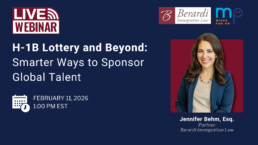
H-1B CAP Lottery for FY 2027
Ready to Make Your H-1B Strategy Smarter (And Less Stressful)?
If you’re looking for immigration guidance or have questions about the H-1B visa process, share your details to connect with Berardi Immigration Law. You’ll receive clear, practical next steps grounded in real legal strategy.
Enter your information on our "Contact Us" page, and we will follow up to schedule your free consultation.
Fill Out Your Contact Information On This Page

Click Here To Download The H-1B CAP FY2027 Guide
Why Berardi Immigration Law
We help employers sponsor global talent every day with practical guidance grounded in real-world business immigration experience.
Berardi Immigration Law takes a clear, business-first approach that turns visa sponsorship into a strategic advantage, not a recurring fire drill.
Enter your information on our "Contact Us" page, and we will follow up to schedule your free consultation.

B-1 & B-2 Visitor Visas
Visitor visas to the United States are primarily categorized into two types: B-1 for Business Visitors and B-2 for Tourist Visitors. These visas are designed for individuals who wish to visit the U.S. for short periods, generally ranging from a few weeks to up to six months, depending on the specific circumstances of each case.
Note that the visitor category is not a work visa, nor does it allow for employment, payment from a U.S. source, or enrollment in formal education programs. Visitors are expected to maintain their foreign residence and demonstrate their intent to return home after their temporary stay in the United States. Engaging in unauthorized activities can result in immigration penalties and affect future travel to the U.S.
- B-1 Business Visitor Visa
The B-1 visa is tailored for individuals engaging in superficial business activities of a commercial or professional nature in the United States, such as attending conferences and trade shows, meetings with business associates, settling estates, or negotiating contracts.
The B-1 visa does not serve as a work permit; it does not allow the visa holder to engage in employment in the U.S. or receive payment from a U.S. source for services rendered during their stay. The B-1 visa is strictly limited to business-related activities. It does not permit holders to engage in hands-on professional services or labor for a U.S. employer, nor does it allow them to participate in any form of paid performances or entertainment. Additionally, B-1 visa holders cannot enroll as students in educational institutions for credit-bearing courses. Engaging in any type of permanent employment or residency is also prohibited under this visa category. The visa strictly serves those looking to engage in legitimate business activities that do not involve gainful employment in the United States.
- B-2 Tourist Visitor Visa
The B-2 visa is intended for visitors who wish to enter the U.S. for tourism, vacation, or leisure, as well as for those visiting friends or relatives. This category also encompasses individuals coming to the U.S. for medical treatment, participation in social events hosted by fraternal, social, or service organizations, and participation by amateurs in musical, sports, or similar events or contests, if not being paid for participating.
- Canadian Visitors to the U.S.
Canadian citizens are unique in the landscape of U.S. immigration as they are generally visa-exempt for visits typically covered under B-1 and B-2 visas. This exemption allows Canadian visitors to enter the U.S. for business or tourism without the need for a visa, streamlining their entry process. Upon entry into the United States, Canadian visitors are inspected by U.S. Customs and Border Protection (CBP) officers who determine the eligibility for entry based on the visitor’s intent. It is crucial for Canadians to clearly communicate the purpose of their visit, as CBP officers assess whether the activities intended align with permissible activities under a visitor status.
- Period of Stay and Extensions
Most visitors, including Canadians and those entering the U.S. on a B-1 or B-2 visa, are typically admitted for a default period of up to six months. Upon entry, each visitor is issued an I-94 record. This electronic document is crucial as it officially notes the length of permitted stay, which is generally up to six months. Visitors can access this record online to verify the duration of their authorized stay and ensure compliance with U.S. immigration laws.
The standard period of stay is set at six months; however, extensions may be granted in certain circumstances. Visitors wishing to extend their stay beyond the initial period granted on their I-94 record must file a request with U.S. Citizenship and Immigration Services (USCIS) prior to the expiration of their authorized stay. It is important to adhere to this process to avoid any complications with future travel to the United States or filing for immigration benefits.
In summary, while the B-1 and B-2 visas facilitate short-term visits to the United States for business and leisure respectively, it is important for potential visitors to ensure they apply for the correct category that aligns with the purpose of their trip. For many eligible travelers, the ESTA offers a streamlined, efficient entry option under the VWP.
Electronic System for Travel Authorization (ESTA)
The Electronic System for Travel Authorization (ESTA) is a vital component for citizens of countries participating in the Visa Waiver Program (VWP). ESTA allows eligible travelers to visit the United States for business or tourism without a visa for stays of up to 90 days. This streamlined process is designed to facilitate quick and secure entries but requires that travelers obtain an approved travel authorization prior to their departure.
Travelers must apply for ESTA authorization via the official U.S. Customs and Border Protection (CBP) website. The application involves answering a series of eligibility questions and providing personal and passport information. It is recommended that applications be submitted at least 72 hours before travel, although decisions are often reached much quicker.
An approved ESTA is valid for two years or until the traveler’s passport expires, whichever comes first. During this period, travelers can make multiple entries into the United States without reapplying for each visit. However, each stay must not exceed 90 days, and the purpose of each visit must align with the conditions of the VWP.
While ESTA facilitates easier entry into the U.S., it is important for travelers to understand that an approval does not guarantee entry. U.S. Customs and Border Protection officers at ports of entry will conduct a final review of the traveler’s documents and purpose of visit. Travelers must also adhere to the restrictions of the Visa Waiver Program, such as not engaging in unauthorized work or extended study, and they cannot change their status while in the U.S.
ESTA offers a convenient alternative to a traditional visa. However, it requires careful consideration and compliance with all its conditions to ensure a smooth and trouble-free U.S. visit.
- B-1 Visas – Berardi Immigration Law
- B-1 Business Visitors – Berardi Immigration Law
- B-1 Visa Permissible Sales Activities – Berardi Immigration Law
- B-1 in Lieu of H-1B May Be Temporary Solution for Some Foreign Workers – Berardi Immigration Law
- B-1/B-2 Visas: Visitors to the U.S. – Berardi Immigration Law
- B-1 or Not B-1? THAT is the question – Berardi Immigration Law
- Essential Travel Itinerary Tips for Business Visitors to the U.S.
- Fact or Fiction for B-2 Visitors – Berardi Immigration Law
- What are B Visas? – Berardi Immigration Law
- Tips for Canadian Snowbirds! – Berardi Immigration Law
- Immigration Tips for Canadian Snowbirds in the U.S. – Berardi Immigration Law
- New Registration Requirements for Canadian Snowbirds
B-1/B-2 Visitor Visa – Frequently Asked Questions
What is a B-1/B-2 Visa?
The B-1/B-2 is a combined nonimmigrant visitor visa that allows travel to the United States on a temporary basis for both business and personal purposes. The B-1 portion covers legitimate business activities such as attending meetings, conferences, or negotiations while the B-2 portion covers tourism, family visits, and other personal activities. Neither category permits U.S. employment or enrollment in a full course of academic study.
Who is eligible for a B-1/B-2 visa?
Eligible applicants must demonstrate they are visiting the U.S. temporarily for a permitted business or personal purpose, intend to return to their home country afterward, have sufficient funds to cover the trip, and demonstrate sufficient ties abroad and an intent to depart the United States at the end of the authorized stay. The specific activities planned must also fall within what is permissible under the B-1 or B-2 categories.
What business (B-1) activities are allowed?
Permitted B-1 activities generally include:
- Attending business meetings, conferences, or conventions
- Negotiating contracts
- Consulting with business associates
- Settling an estate
- Participating in short-term training programs (with limitations)
- Purchasing goods or materials on behalf of a foreign employer
- Performing certain after-sales installation, service, or training obligations when permitted under a qualifying contract
The common thread is that the work itself, and the paycheck, stays tied to the employer abroad, not a U.S. company.
What personal/tourist (B-2) activities are allowed?
Permitted B-2 activities generally include:
- Tourism and vacation travel
- Visiting family or friends
- Receiving medical treatment
- Participating in social events, such as weddings or family gatherings
- Short-term, non-credit recreational courses (for example, a two-week cooking class)
- Amateur participation in music, sports, or similar contests or events, provided there is no payment involved
The common thread is that the visit is personal in nature, not work- or study-related.
What activities are NOT allowed on a B-1/B-2 visa?
B-1/B-2 visa holders cannot perform “productive employment” in the U.S., accept a salary or payment from a U.S. source, work directly for a U.S.-based employer, or enroll in a full course of academic study. Activities involving productive employment, providing services to a U.S. employer, or engaging in work that requires employment authorization generally fall outside the scope of B-1/B-2 status.
How long can I stay in the U.S. on a B-1/B-2 visa?
Admission periods are determined by U.S. Customs and Border Protection (CBP) at the port of entry, typically up to six months, even if the visa itself is valid for a longer period (in some cases up to 10 years for multiple entries). The visa’s validity period is not the same as the authorized length of stay.
Can a B-1/B-2 visa be extended?
Yes. A B-1/B-2 visa holder may apply for an extension of stay by filing Form I-539 with U.S. Citizenship and Immigration Services (USCIS) before the authorized period expires, provided the request is supported by a continued legitimate business or personal need, such as ongoing negotiations or medical treatment. Approval is discretionary and filing an extension request does not guarantee it will be granted.
Does the B-1/B-2 visa allow dual intent?
No. Unlike visas such as the H-1B, the B-1/B-2 does not recognize dual intent. Applicants must show nonimmigrant intent, meaning they plan to depart the U.S. once their business activities or visit conclude and are not seeking a path to permanent residence during this trip.
Can I work or be paid a salary while on a B-1/B-2 visa?
No. B-1/B-2 visa holders may not accept employment or receive a salary or other payment from a U.S. source for services performed in the United States. Compensation must continue to come from the employer abroad, and any U.S.-based reimbursement is typically limited to legitimate business expenses (such as travel and lodging).
What documents are required for a B-1/B-2 visa application?
Typical requirements include a completed Form DS-160, a valid passport, a passport-style photo, evidence of the purpose of travel (such as an invitation letter, meeting itinerary, or travel itinerary), evidence of ties to the home country, and proof of sufficient funds. Consular officers may request additional documentation depending on the applicant’s circumstances.
Do I need a visa if I’m from a Visa Waiver Program country?
Citizens of Visa Waiver Program (VWP) countries may be able to travel to the U.S. for business or tourism purposes for up to 90 days using an approved ESTA authorization instead of a B-1/B-2 visa, provided the trip fits within the same permitted business or personal activities.
Can my spouse or children accompany me?
Spouses and children do not automatically share a B-1/B-2 visa holder’s status. Family members who wish to accompany a visa holder typically need to apply individually, usually under the B-2 category if visiting for personal reasons, or qualify under the Visa Waiver Program independently.
What are common reasons a B-1/B-2 visa application is denied?
Common grounds for denial include failure to demonstrate strong ties to the home country, insufficient evidence of the business or personal purpose, prior immigration violations, or an application that suggests an intent to work locally or remain in the U.S. longer than the visit described.
Can a B-1/B-2 visa lead to a green card?
The B-1/B-2 visa itself does not provide a direct path to permanent residence, and applicants must demonstrate nonimmigrant intent at the time of application. Travelers exploring long-term U.S. opportunities, whether through employment, marriage, or family sponsorship, should discuss appropriate visa categories with an experienced immigration attorney rather than relying on a B-1/B-2 visa for that purpose.
How far in advance should I apply for a B-1/B-2 visa?
Processing times vary by consulate and season, so applicants are encouraged to apply well in advance of their intended travel date, often several weeks to a few months ahead, to account for interview scheduling and administrative processing.
B-1 Visas
B1 Visas for Personal Employees/Domestic Workers of U.S. Citizens Residing Abroad
Personal employees or domestic workers may accompany or follow to join a U.S. citizen employer who is traveling to the United States temporarily, provided the U.S. citizen employer has a permanent home abroad or is stationed in a foreign country, and that certain requirements are met. This category for domestic employees includes, but is not limited to, cooks, butlers, chauffeurs, housemaids, valets, footmen, nannies, mothers' helpers, gardeners, and paid companions.
B-1 Visa Requirements for Domestic Employees of U.S. Citizens
Personal employees or domestic workers may accompany or later join a U.S. citizen employer who is traveling to the U.S. temporarily, provided the U.S. citizen employer has a permanent home or is routinely stationed in a foreign country. To qualify for B-1 status, the domestic worker must demonstrate that the following requirements have been met:
- The employer ordinarily resides outside the U.S. and is traveling to the U.S. temporarily;
- The employee has a residence abroad which he or she has no intention of abandoning;
- The employer-employee relationship has existed for at least six months prior to the employer's admission to the U.S. Alternatively, the employer can show they regularly employ a domestic employee in the same capacity as the intended applicant while abroad;
- The employee can demonstrate at least one-year experience as a personal employee or domestic worker by producing statements from previous employers attesting to such experience. (These statements are typically in the form of employment contracts or confirmation letters); and
- The employee has an employment contract that has been signed and dated by the employer and employee and includes all requisite provisions (provided below).
If the U.S. citizen employer will be traveling to the U.S. for an extended period of time for employment, it must be shown that the employer routinely resides abroad and works outside the U.S., and that their return to the U.S. is temporary and will be no more than six years.
The Employment Contract
The employee must be able to present a valid employment contract which has been signed and dated by the employer and employee. The contract must include specific provisions, including (but not limited to) the following:
- The employee will receive the greater of the minimum or prevailing wage under U.S. federal, state, or local law for an eight-hour work day;
- The employer will provide the employee with free room and board in the U.S. and round trip airfare;
- A certification that both parties understand that the employee cannot be required to remain on the premises after working hours without compensation;
- The employer will be the only provider of employment to the employee;
The employment contract must reflect any other benefits normally required for U.S. domestic workers in that area of employment.
Application Process
There are several steps involved with B-1 cases for domestic workers. First, the Berardi team will prepare a detailed B-1 application packet addressing the employee’s qualifications for B-1 status. Our attorneys will provide guidance on the documentation needed from the employer and domestic employee to prove eligibility, and we will assist with the employment contract if needed.
The domestic employee will use this packet to apply for a visa and entry into the U.S. The Berardi team will then schedule a visa appointment for the employee at a U.S. Embassy or Consulate abroad. There, the employee will present the B-1 application packet to the consular officers and discuss their qualifications. Upon approval, the employee’s passport will be returned in 3-5 business days with the B-1 visa. The B-1 visa may be granted anywhere from a six month to 10-year period, at the discretion of the interviewing officer. Upon receipt of the B-1 visa, the employee may enter the U.S. as a visitor and will be admitted to the U.S. for up to a six-month period.
Upon admission to the U.S. in B-1 status, the employee must then apply for an Employment Authorization Card (Form I-765, Application for Employment Authorization). The Berardi team will assist with this application. The amount of time it takes for an EAD card to be issued is dependent on current government processing times and can range from 3-9 months (subject to change). The EAD card will be limited to the expiration date of the employee’s I-94 admission period provided at the time of entry to the U.S.
Work Authorization
Upon receipt of the EAD card, the employee may apply for a U.S. social security number and receive salary from a U.S. source. Domestic employees in B-1 status are subject to the same taxation obligations as any U.S. wage earner, and they are granted the same worker protections (see Fair Labor Standards Act) as U.S. workers.
Domestic workers are only permitted to work for their employer in the capacity outlined in the employment contract. If an employee violates their B-1 status, it could lead to serious long-term immigration consequences.
Maintaining B-1 Employee’s Status
An employee on a B-1 visa is typically granted an initial period of entry of 6-12 months. The employee can apply for an extension of status (Form I-539, Application for Extension of Status) in increments of six months, which can be filed with a renewal of the Employment Authorization Card.
The accrual of unlawful presence in the U.S. can have serious consequences on their ability to return to the U.S. in the future. It is critically important that the employee track the expiration dates of their visa, I-94 admission period, and EAD card. All will likely have varying expiration dates and must be closely monitored. It is important to keep the Berardi team appraised of the B-1 worker’s international travel plans or need to stay physically present in the U.S. for extended periods.
Green Card Holders and Diplomat Employers
U.S. Lawful Permanent Residents (Green Card holders) are not permitted to bring their domestic workers to the United States on a B-1 visa.
Domestic employees accompanying or following to join an employer who is a foreign diplomat or government official may be eligible for an A-3 or G-5 visa, depending upon their employer's visa status.
Berardi Immigration Law
Berardi Immigration Law regularly helps domestic employees obtain B-1 status. Our lawyers provide an individualized approach for each client. If you are interested in bringing a personal employee or domestic worker into the United States, be sure to contact Berardi Immigration Law to schedule a consultation with one of our attorneys today!