
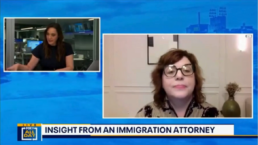
As reports of ICE agents going door-to-door across Minnesota raised concern and confusion, FOX 9 Minneapolis–St. Paul turned to Berardi Immigration Law Managing Partner, Rosanna Berardi Esq, for clarity on what’s actually happening, and what the law says.
In her interview with Amy Hockert, Berardi explained that the surge in visible enforcement is directly tied to expanded ICE funding under the Big Beautiful Bill Act signed in July 2025, while emphasizing that immigration law is federal law, regardless of intent or sympathy. Most critically, she outlined the difference between judicial warrants, which are signed by a judge and allow agents to enter a home, and administrative warrants, which do not; meaning individuals are not required to open their door or allow entry.
Rosanna underscored that everyone physically present in the U.S. has constitutional rights, including due process, and warned against neighbors inserting themselves into enforcement actions without knowing the underlying facts. Her message was clear: understand your rights, stay calm, respect law enforcement directives, and don’t assume every knock (or every piece of paper labeled “warrant”) carries the same legal authority.
Watch The Full Fox 9 Segment Here
Interview Transcript:
Amy: We wanted to check in with an Immigration Attorney for some more insight. Joining me now is Rosanna Berardi, managing partner at Berardi Immigration Law based out of Buffalo, New York, but representing people across the country. Um, thanks for joining us.
Rosanna: Pleasure, thanks for having me.
Amy: Yeah, we spoke to you, I think it was, gosh, almost maybe a year ago about some other, uhm, some other topics. And we thought we’d bring you in as somebody who’s kind of been watching a bit, but also as an immigration attorney, um, just, you know, curious right off the bat here, some of your thoughts as you’ve been watching things kind of play out here in, in the Twin Cities.
Rosanna: Well, it’s been certainly an alarming sight to see. But I can’t help but think back to July 4th of 2025, when the Big Beautiful Bill Act was signed in law by, you know, voted by Congress and signed by President Trump. And why am I thinking about that? Because, ICE was funded billions of dollars to hire more enforcement agents, um, to have more people’s boots on the ground, if you will. And I think this large-scale operation that we’re seeing in the state of Minnesota is directly linked to ICE funding. It’s us having more funding in order to propel the Trump administration’s agenda to fix immigration.
Amy: And we know, Roseanna, that obviously President Trump was elected, and one of the things that he ran on was being tougher on crime, America first. And he talks about going after, you know, the worst of the worst, and pulling these criminals off the streets. Um, so we know we got into office for that reason. We know that there are people here in Minnesota who are wanting this. They see this and they say, yeah, we want, we’re seeing these criminals coming off our streets. So from your perspective as an immigration attorney, how do you kind of, how do you manage that line of understanding that there are people, uh, who are here undocumented, who, who may be dangerous to the community, but also protecting those who are here, um, and who are. are not posing that kind of a danger.
Rosanna: Yeah, it’s definitely a hard and difficult line to walk for law enforcement.
I think average American, you know, wants to fix immigration. Does that mean knocking on doors and pulling people out of their homes? A little bit aggressive, I would gather for most Americans. Um, we never know. The hard part of my job is we never know what law enforcement has in terms of information. Now, people will say they’re here in documented. They just want to live here. They just want to live a better life. Well, the federal immigration law is a federal law. Doesn’t matter your intention of, do you want a better life? Is there a better economy? If the law’s been broken, then law enforcement has a basis in order to approach that individual and see what’s going on.
Um, and I think the criminal part, listen, if somebody is a criminal and there is an outstanding warrant for an arrest and ICE, you know, executes that warrant, that’s a hard argument to make. That’s a law enforcement job. Um, but going door to door like. This, again, we don’t know what’s going on from the law enforcement perspective and we never will, right? That is secured information. We’re not going to get that information, but there’s a fine line here and in terms of neighbors wanting to help. So to have this broad umbrella over an entire neighborhood, we’re going to protect everybody’s here and not really know that can be a misstep.
Amy: I’m curious about, we just heard a city councilman from Minneapolis talk about this door to door and DHS actually put out a statement right after that saying yes, we are confirming that agents are going door to door in Minnesota. I would have to investigate fraud. Um, from, I guess, a, a rights perspective, a legal perspective. If you are in your home and there’s a knock at the door, what, what are your rights?
Rosanna: So this is very important for everyone to listen to. Doesn’t matter if you’re. Thank very much. Born in the United States or foreign national. There’s a knock on the door. You’re not required to open that door. If you hear on the other side, this is ICE or Immigration and Customs Enforcement, you must ask, do you have a warrant? And if they say yes, ask for that warrant to be slipped under the door. Or pass through the door. Now, the hard part here is not all warrants are created equally.
So there are judicial warrants that require law enforcement to show evidence to a judge and say, there’s a reason why we want to knock on this door. Umm. get out of Yeah. Yeah. Mhm. And those are signed off by a judge and those judicial warrants do have the power to brick to allow the government to go inside the promises and search whatever the judge signed off on. What’s sticky here is there’s also another type of warrant. for it. Um, you know, called an administrative warrant that’s issued by Homeland Security or ICE or any one of those agencies. If someone’s knocking on your door and slips an administrative warrant under your door, you do not need to allow them to come in it. You can say, “I’m sorry, I’m not allowing you in.” And if they start creating a ruckus or what have you, you need to commonly be respectful to a law enforcement officer and say, I would like to see a lawyer, I’d like to call my lawyer. I’m not letting you in at this time. Now, in a moment’s notice, right? These are inflammatory situations. You got to remember there’s two different warrants and I would gather given the presence of ice and DHS.
Most of these warrants are going to be administrative in this situation. But that’s the clear distinction. And individuals have to be aware of the fact that not every piece of paper that has the word warrant on it is created equally. And if it is not signed off by a judge, the government does not have the power of the authority to go into the premises and search.
Amy: Okay, that is really, really important information. I think a lot of people are just kind of trying to educate themselves on what is the law and what isn’t. And, um, to have this, you know, when, when, when we see a councilman out there in a neighborhood. And, and neighbors who are saying they’re, they’re going door to door, they’re going door to door. Um, I think a lot, a lot is getting lost, but I think they’re, you know, there are instances where there’s administrative warrants. Clearly you’re saying there’s instances where there’s judicial. Is it, is it legal for these agents to go? Hello. Just door to door randomly? Or can, can they do that and people can just not open the door? Or, what are, what are the, the rights here?
Rosanna: So anybody that’s physically present in the United States has constitutional rights. It doesn’t matter. There it is. If you were born in the U.S., if you were born in Afghanistan, if you were born in Italy, everyone physically present on U.S. soil has constitutional rights. So, right to free speech, right? Could say whatever you want most of the time, unless it’s inflammatory or it’s. It’s gonna result in some type of harm or danger. You have right to do process. So, if the government’s knocking on your door and they do have a warrant, a valid judicial warrant to search and they find something, maybe there’s drugs in the premise or guns, they tend to. That doesn’t mean they’re going to put you on an airplane. Because you’re physically present in the U.S., you’re protected under the Fourth Amendment. You get due process.
What does that mean? That means you’re day in court. Now, will you get it that day? It’s unlikely. The system’s clogged. But there are provisions and protections. We’re hearing a lot of murkiness about them, because the government’s all over it right now, and there’s a lot of people in the system. But an individual is not going to be ripped out of their home, put out an airplane and set up. We don’t have that in the United States, thankfully.
Amy: Okay. As we’re talking about sort of differences and understanding specifics, I think another thing that might be really helpful to try to understand, uh, in addition to two types of warrants. So if someone comes to your home, you ask if it’s a judge’s warrant or an administrative warrant, and the judges means that they can come in.
Aside from that, when we talk about arrest and detain, um, you know, we had, we had the Minneapolis Police Chief, uh, about a month ago say, if you see some- thing that doesn’t look right, somebody’s getting swept up, or, um, and so they had a lot of calls into 911, and so maybe trying to help people understand the difference between arrest and detain, um, and again, we don’t know exactly what’s happening on the streets, um, there are hundreds and hundreds. Countless incidents, and we’re not able to verify every single one of them. But generally speaking, uh, Roseanna, what do you want people to know about what they may be seeing?
Rosanna: Well, what they may be seeing is rooted in law enforcement investigation and data. We all love our neighbors. We all want to help our neighbors. But as I said earlier, you don’t know in detail what is going up. I love the sense of community in America.
I love the sense of protection. But we also have law enforcement. And whether you like that or not. Law enforcement is doing their job based on information they have that you and I will never know. The general public will never know that. That’s redacted because it’s high level law enforcement information. So if you see something. I’m gonna, It’s disturbing. You don’t think it looks right to you. Don’t call 911. If you know your neighbor’s family, um, call a family member or try and look at it. But the last thing to do is try and interject yourself in that situation. It’s very, very dangerous to do that. And again, the issue is we don’t know all of the details, right? We don’t know the government side. We don’t know the individual side. We might know that we love our neighbor next door, but we have no idea if that individual. Has a criminal record or has guns or drugs inside.
So, law enforcement, I think it’s really important. I used to be an officer at the border to be respectful. Everyone’s they’re doing a job. Everyone is there being told to do this job. If it doesn’t look right. I wouldn’t try and insert myself into that scenario because you’re not going to win. Law enforcement is going to be able to do what they are there to do. If they have that warrant, if they have data or information that they can adequately pursue. Uh, law enforcement is there. They’re not doing it ad hoc. It seems like they are because of the volume of people in the area right now. But this is done very strategically and we see it in many layers of law enforcement. So inserting yourself in the middle of a confrontation like that, I would highly advise against that.
Amy: And finally, Rosanna, I guess if people, you know, hear that and they say, I hear you, Rosanna, I, you know, I just want to go and I want a document and I want to just do something. What do they do? They need to know about their, their rights to document the rights of law enforcement as well in those situations.
Rosanna: Well, this is a hard one because everybody has, you know, a camera now and their phone. Um, I guess if you’re doing it safely from a distance, you’re. Okay, but again, if law enforcement tells you to do something I personally, even as an attorney, would definitely follow their word and, you know, drop, whether you’re taking a few pictures or videos, if you’re told not to do it, I wouldn’t do it. But, um, you know, it’s, there’s a lot of. Things going on in those situations and it’s hard to stop. So if they want to document it, you know, if it’s a reasonable situation, I would say by all means that would be okay.
Amy: Yeah, and we don’t have time to get into it, but I think obstruction is a word that we’re using a lot and we’re not really getting into details of what obstruction means. Maybe we can pick that up in another conversation with you. Thanks for joining us today. Really, really appreciate it. Your insight today as an immigration attorney, uh, in Buffalo. Thanks, Roseanna.
Rosanna: Thanks for having me.
Amy: All right. Take care.



Ready to have Berardi on your side?
Whether you’re a business looking to hire or a professional hoping to relocate, immigration law can be complicated. But you don’t have to do it alone. Put our experience to work for you.